
Santa Barbara · Generator Installation and Service
Industrial Generators
Three-phase diesel and gas gensets from 100kW upward for agriculture, wineries, water systems, cold storage and manufacturing.
Industrial Generators · Santa Barbara
What An Industrial Generator Has To Do
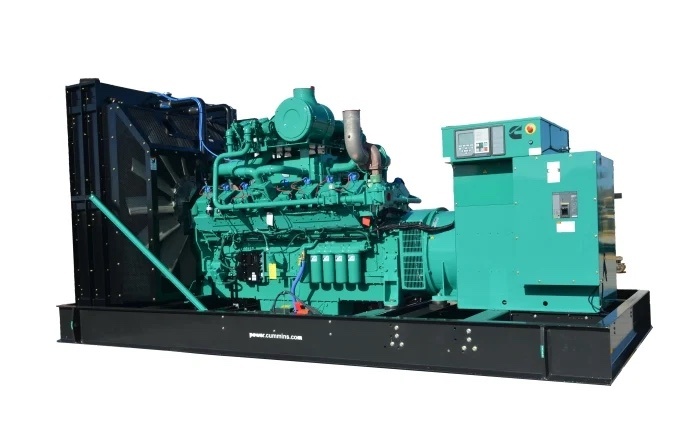
Industrial generators are a different discipline from residential standby, and the difference is not only size. These are three-phase machines from roughly 100kW to 2MW, usually diesel, usually feeding process loads where the failure mode is a ruined batch, a flooded pit or a crop rather than an inconvenient evening. We install, service and rent them across Santa Barbara County for agricultural pumping and cooling, wineries, cold storage, water and wastewater districts, food production, fabrication and the light manufacturing tenants along Hollister Avenue and the 101 corridor. The work that separates a good industrial installation from a poor one happens on paper: measuring the real demand rather than reading the panel rating, calculating starting kVA on the largest motors, deciding between one machine and a paralleled pair, planning fuel storage and containment, and building in a load bank test so the system is proven under genuine load rather than assumed to work. Diesel generators dominate this category because they hold up under sustained heavy load and store their own fuel on site, though gas generators make sense where a main is available and emissions rules are tight. Where a site needs power for a season rather than forever, an industrial generator rental covers it without the capital.
Why Go With Us On Industrial Work
Most industrial generator problems trace back to a sizing decision made years earlier by somebody who never saw the site under load. A unit chosen from a panel schedule rather than a measured demand study either runs hopelessly light, which fouls a diesel engine over time, or drops out the first time two motors start together. We do the load study properly, including starting kVA on the specific motors involved, and we say so when the honest answer is a smaller machine than the one you asked us to quote. We also test what we install. A load bank test at commissioning and again annually is the only way to know a set will hold at rated output, and it is the same test an insurer or an inspector will eventually ask about. Our technicians carry the diagnostic tools for the controllers actually used in this market, and we stock the filters, belts and fuel components that a Central Coast diesel set goes through, so an emergency generator repair in Lompoc at harvest is not a parts-ordering exercise.
- Measured demand studies and starting kVA calculations, rather than sizing off the panel rating.
- Load bank testing at commissioning and annually, with documentation for insurers and inspectors.
- Fuel management including polishing, tank testing and containment, so stored diesel is still good when the site needs it.
- Tier 4 Final compliant units and help with the air district paperwork on permitted sources.
- Paralleling and redundancy design for sites that cannot accept a single point of failure.
- Rental units available on short notice to cover an outage while a permanent set is repaired or replaced.
Reasons To Install An Industrial Generator
Industrial sites reach this decision for reasons that are usually already quantified:
The process cannot be interrupted
Fermentation, cold-stabilization, refrigeration, plating, curing and continuous production lines all fail expensively when power stops mid-cycle. Where a shutdown means scrapping work in progress rather than pausing it, backup stops being a capital argument and becomes an operating requirement.
Irrigation and pumping cannot wait
Agricultural pumping, frost protection and water district lift stations have to run when they have to run. Weather does not reschedule, and a pump station without power during a storm is how a pit floods. These loads also have brutal starting current, which is why they need proper sizing rather than a nominal one.
Cold storage holds product
A freezer coasts for a while and then it does not. For growers, food producers and distributors on the 101 corridor, the value sitting inside the building usually exceeds the cost of a generator by a wide margin, and insurers increasingly want to see a working backup system rather than a plan.
Public safety power shutoffs reach the site
Inland and north county operations sit in areas the utility de-energizes during red flag conditions, and those events happen in the driest, most operationally sensitive part of the year. A site that plans for it runs through the shutoff; a site that does not sends everybody home.
The utility service is the bottleneck
Expanding operations sometimes outrun the available service, and a utility upgrade can be a multi-year project. A generator can carry the new load or shave peaks while the upgrade works its way through, which is often the only route to getting production online this year.
Compliance requires proof, not intent
Where a permit, a lease or an insurance policy requires standby capacity, what is actually required is documentation: a load test, a service record, a maintained log. We install with that in mind and provide the paperwork, because a system nobody can evidence is a system that does not count.
Send us the motor schedule, the process load list and the site plan, and we will come back with a sizing recommendation you can defend. Call: (805) 572-7405
How An Industrial Project Runs
Longer than a residential job, and nearly all of the risk sits in the first stage.
1. Load study and site assessment
We log actual demand where we can, list every motor with its starting characteristics, review the single line diagram and look at what the site will need in five years rather than today. Then we recommend a rating, a fuel, a location and an enclosure, with the reasoning written down.
2. Permits, emissions and coordination
Industrial sets touch the building department, the fire department for fuel storage, and often the air pollution control district for the engine itself. We handle those submissions and coordinate with your electrical engineer, general contractor and utility so the timeline is realistic rather than hopeful.
3. Installation and integration
Foundation, set placement, fuel system with containment, exhaust and cooling, transfer switch or paralleling switchgear, controls and remote monitoring. On live sites we phase the work around production, which usually means the tie-in happens on a weekend rather than a Tuesday afternoon.
4. Load bank test and handover
Commissioning with a resistive load bank at rated output, a full transfer test, controls verified, alarms proven, and the operating and maintenance documentation handed over. Then a service agreement with scheduled inspections and an annual test, because unmaintained industrial sets fail in expensive ways.
Ratings, Fuel, Paralleling And Testing
The parts of an industrial system that decide whether it works on the day:
Standby, prime and continuous ratings
The same engine is rated three ways. Standby is for emergency use with a variable load and no overload capacity. Prime rating suits sites running the generator as the main supply for long periods, such as remote agricultural pumping. Continuous rating is for constant full load. Buying a standby-rated set for prime duty is one of the most expensive specification mistakes in this industry.
Diesel generators
Diesel is the workhorse for anything above about 100kW: high output per gallon, excellent behavior under sustained heavy load, fuel stored on site independent of any main. The trade-off is fuel that degrades, so anything holding more than a few hundred gallons needs polishing and periodic testing. Diesel generator repair and fuel maintenance are covered on the generator repair page.
Gas generators
Natural gas sets remove fuel storage and the emissions arguments that come with diesel, and they suit sites with a good main and tight air district conditions. They cost more per kW and respond slightly more slowly to sudden load, which matters where large motors start abruptly. On the right site they are clearly the better answer.
Paralleling and redundancy
Two smaller sets running in parallel give redundancy, better efficiency at part load and the ability to service one without shutting the site down. It costs more in switchgear and controls than one large machine. For water districts, food production and anywhere a single failure stops everything, it is usually worth it.
Emissions and Tier 4 Final
Non-road diesel engines are subject to EPA tier standards, and the Santa Barbara County Air Pollution Control District permits and limits stationary engines including their annual run hours. Tier 4 Final units are required on most new installations and on public works. We handle the permitting rather than leaving it with you.
Load bank testing
Standby sets spend their lives lightly loaded, which glazes cylinders and leaves wet stacking in diesel engines. An annual load bank test runs the set at rated output, burns that off, and proves the machine will actually hold. It is also the test that produces the certificate your insurer or inspector wants to see.
Temporary and bridging power
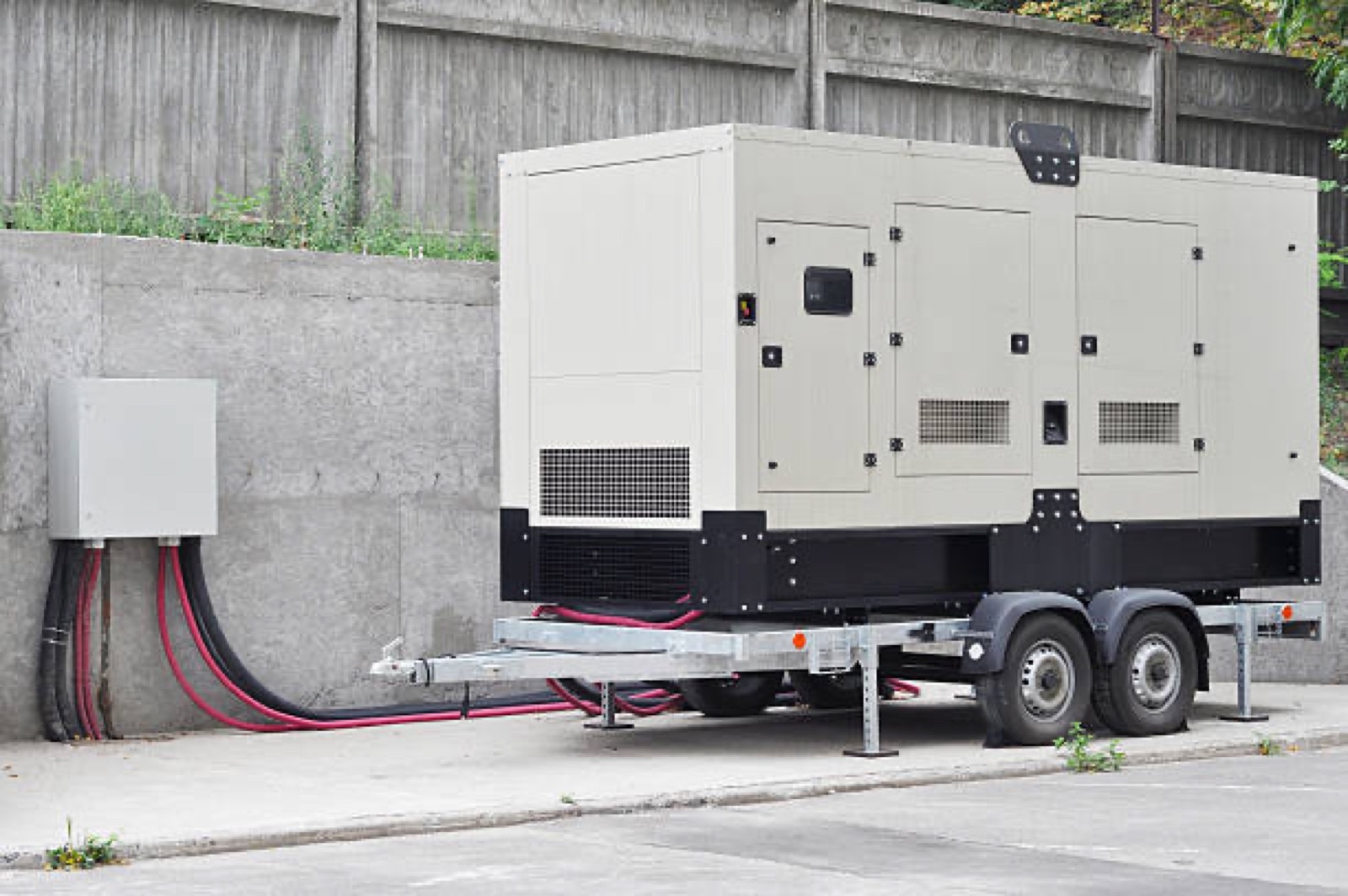
Plant expansions, utility upgrades, seasonal peaks and generator replacements all create gaps where a site needs a large temporary set. We rent trailer-mounted and skid-mounted units up to megawatt scale with cable, distribution and fuel service included, which is set out on the generator rental page.
What Industrial Generators Cost
Industrial installations are quoted per project rather than per unit, and a complete three-phase system usually starts around $30,000 and runs well into six figures at megawatt scale. What drives it:
- Rating and duty. A 150kW standby set and a 500kW prime-rated set are different orders of cost, and the duty cycle you are buying for matters as much as the number.
- Fuel system. Base tanks are straightforward. Bulk storage brings containment, fire department review, monitoring and a fuel maintenance plan with it.
- Switchgear. A single automatic transfer switch is simple. Paralleling switchgear, load shedding and integration with existing controls are a significant share of a large project.
- Site work. Foundations, cranes, exhaust routing, sound attenuation and getting a large set into a constrained yard are real line items, particularly on established industrial sites.
- Emissions and permitting. Air district permitting, Tier 4 compliance and any required after-treatment add cost and, more importantly, time.
- Service agreement. Scheduled inspections, oil and filter changes, fuel polishing and the annual load bank test are an operating cost worth budgeting from the start.
We quote from a load study rather than a phone call, and the study is worth having even if you buy the equipment elsewhere. Smaller buildings are usually better served by a commercial generator package, and short-term needs by an industrial generator rental. Everything we install and maintain is listed on the Santa Barbara generator services page.
Frequently Asked Questions
What size industrial generator do I need?
It comes from a load study, not from the service size. We list every motor and process load, calculate running demand and starting kVA, and add headroom for growth. Sizing from the panel rating usually produces a set that is far too large, which runs lightly loaded and fouls a diesel engine, or one that drops out when two large motors start together. The study is a short piece of work and it is the most valuable part of the project.
Diesel or natural gas for an industrial site?
Diesel for most sites above 100kW: better output per gallon, better behavior under sustained heavy load and fuel stored on site independent of the utility. Natural gas where there is a good main, where fuel storage is unwelcome and where air district conditions are tight. Gas costs more per kW and responds a little more slowly to abrupt load steps, which matters with large motor starting.
What is a load bank test and how often do I need one?
A load bank applies a controlled artificial load so the set can be run at its rated output without involving your building. It proves the machine will hold, and on a diesel it burns off the wet stacking that light running leaves behind. Annually is the standard for standby sets, and it is what produces the certificate insurers and inspectors ask for. We do it at commissioning and then on the service schedule.
Do I need an air district permit for a stationary generator?
Usually yes for stationary engines above a modest threshold. The Santa Barbara County Air Pollution Control District permits these sources and limits annual run hours, and new installations generally need Tier 4 Final compliant engines. We prepare and file the application as part of the project, because a set installed without the permit is a compliance problem waiting to be discovered.
Can you keep our site running during the installation?
Yes. On live industrial sites we phase the work and schedule the tie-in around production, typically overnight or at a weekend, and where a shutdown is unavoidable we bring in a temporary rental set to cover it. That is standard practice for us on food production and cold storage work, where an unplanned outage is not something the site can absorb.
How long does a diesel generator last?
A well-maintained industrial diesel set will run for decades in standby service, and engine hours matter more than years. What kills them early is neglect: stale fuel, missed oil changes, coolant left past its life, and years of light running with no load bank test. A set on an annual service contract with clean fuel will still be dependable long after an ignored one has failed at the worst moment.
Need power that stays on?
Tell us the property and what has to keep running, and we will come back the same day with a free estimate and a flat installed price.
Or call us now: (805) 572-7405